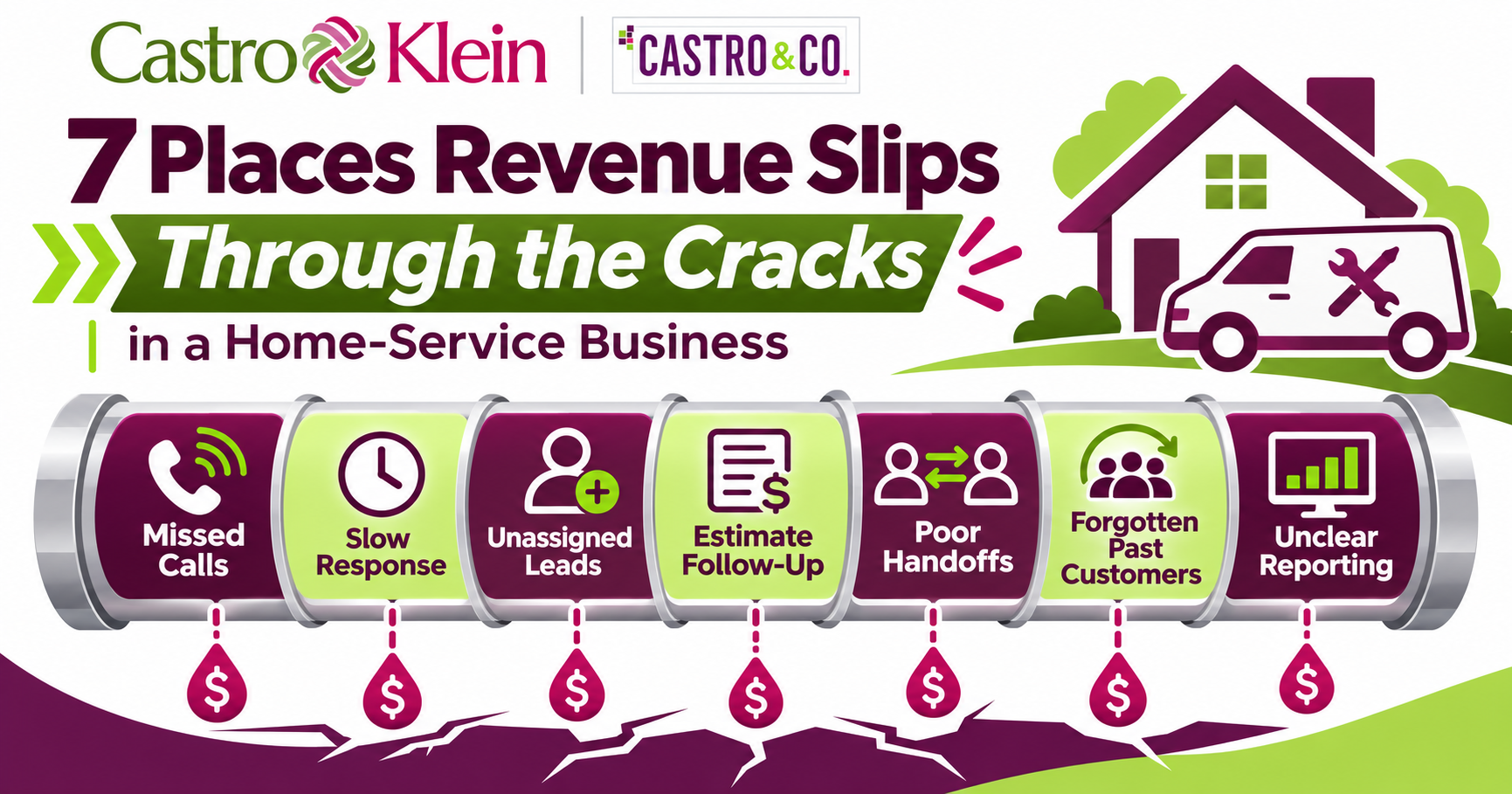
Most home-service businesses do not lose revenue because nobody is calling.
They lose it in the space between the call, the estimate, the follow-up, the handoff, and the final decision.
The frustrating part is that these gaps are usually small enough to go unnoticed. One missed call does not seem like a crisis. One estimate without follow-up does not feel like a major problem. One customer who never hears back may simply look like a lost job.
But when those things happen repeatedly, they add up.
If your business is already generating leads, here are seven places worth looking before you spend more money trying to generate even more.
1. Missed Calls That Never Get Recovered
A missed call can turn into someone else’s job very quickly.
Your team may be in the field, helping another customer, or handling three other things when the phone rings. That is normal.
The important question is what happens next.
Is the missed call automatically captured somewhere? Does someone have clear responsibility for calling back? How quickly does that happen?
If the process is simply “someone will get to it,” some of those opportunities are going to disappear.
2. Slow Response to New Inquiries
Not every lead comes through the phone anymore.
Website forms, emails, social messages, referrals, and other inquiries may all enter the business in different places.
That can make response time surprisingly inconsistent.
One lead gets called back in five minutes while another sits in an inbox until the next morning.
A simple place to start is to look at every way a potential customer can contact you and ask how quickly someone actually responds.
3. Leads Without a Clear Owner
Sometimes everyone can see the lead, but nobody is quite sure who owns it.
The office thinks sales is handling it. Sales assumes the office already responded. Someone mentions the prospect in a text, but the conversation never makes it into the main system.
This is how opportunities quietly disappear.
Every lead should have a clear next step and a clear person responsible for making it happen.
4. Estimates That Go Out and Then Sit
Sending the estimate is not the end of the sales process.
It is often the point where the sale needs the most attention.
If follow-up depends on someone remembering which estimates are still open, it is easy for good opportunities to go cold.
Look at your open estimates and ask:
Who follows up? When do they follow up? Where is that activity tracked? What happens if the customer says they need another week?
If there is no consistent answer, there is likely revenue sitting in the pipeline.
5. Handoffs That Lose Important Information
A customer should not have to repeat the same information every time they talk to someone new.
But in many businesses, the details collected during the first call do not always make it cleanly to sales, scheduling, the field team, or billing.
That creates extra work for the team and a frustrating experience for the customer.
It can also create expensive mistakes when promises, pricing details, or job requirements are missed.
A good handoff should make the next person’s job easier, not send them searching for information.
6. Past Customers Nobody Talks to Again
There may be revenue sitting in your customer list right now.
Past customers already know the company. They may need another service, seasonal maintenance, additional work, or simply a reminder that you are still there.
But when there is no process for staying in touch, those relationships can quietly disappear.
Revenue recovery is not only about new leads. Sometimes it means making better use of the customers and relationships you already worked hard to earn.
7. Reporting That Does Not Show Where the Problem Is
It is difficult to fix a revenue leak you cannot see.
You should be able to answer basic questions without digging through emails, spreadsheets, and multiple systems.
How many leads came in? How quickly were they contacted? How many estimates are still open? How many opportunities were lost? Why were they lost?
If the reports cannot answer those questions, the problem may not be the numbers themselves. It may be what is happening earlier in the process.
Start With the Gaps You Already Have
The answer is not automatically another CRM, another automation, another employee, or another marketing campaign.
Sometimes one of those things is exactly what the business needs. But it is much easier to choose the right solution once you know where the actual problem is.
That is the purpose of the Revenue Recovery Roadmap from Castro Klein.
It is designed for trades and home-service businesses that already have leads coming in but want a clearer picture of where missed calls, delayed estimates, inconsistent follow-up, and broken processes may be costing them jobs.
Instead of guessing, the Roadmap helps identify the biggest revenue gaps and prioritize what should be fixed first.
Explore the Revenue Recovery Roadmap at castroklein.com/revenue-recovery.